





New ideas for automation transformation – ”industrial robots”


Industrial robots are widely used in industrial manufacturing, such as automobile manufacturing, electrical appliances, food, etc. They can replace repetitive machine control work and are machines that rely on their own power and control to achieve various functions. It can withstand human command and operate according to pre arranged programs.
The development of industrial robots
In March 1938, The Meccano Magazine reported on a model of a handling robot, which was the earliest report on a robot model aimed at industrial applications. It was designed by Griffith P. Taylor in 1935 and can achieve movement of 5 axes through an electric motor. In 1954, G.C. Devol from the United States designed the first electronically programmable industrial robot. In 1960, the American company AMF produced the column coordinate Versatran robot, which could perform point and trajectory control, making it the world’s first robot applied to industrial production.
Composition of industrial robots
Nowadays, most industrial robots consist of a main body, a drive system, a control system, a perception system, and end effectors.
The main machinery refers to a multi degree of freedom mechanical system consisting of a machine base and an implementing mechanism, including a large arm, a small arm, a wrist, and a hand. Some robots also have walking mechanisms. Industrial robots have 6 degrees of freedom or even more, and the wrist has 1-3 degrees of freedom of movement.
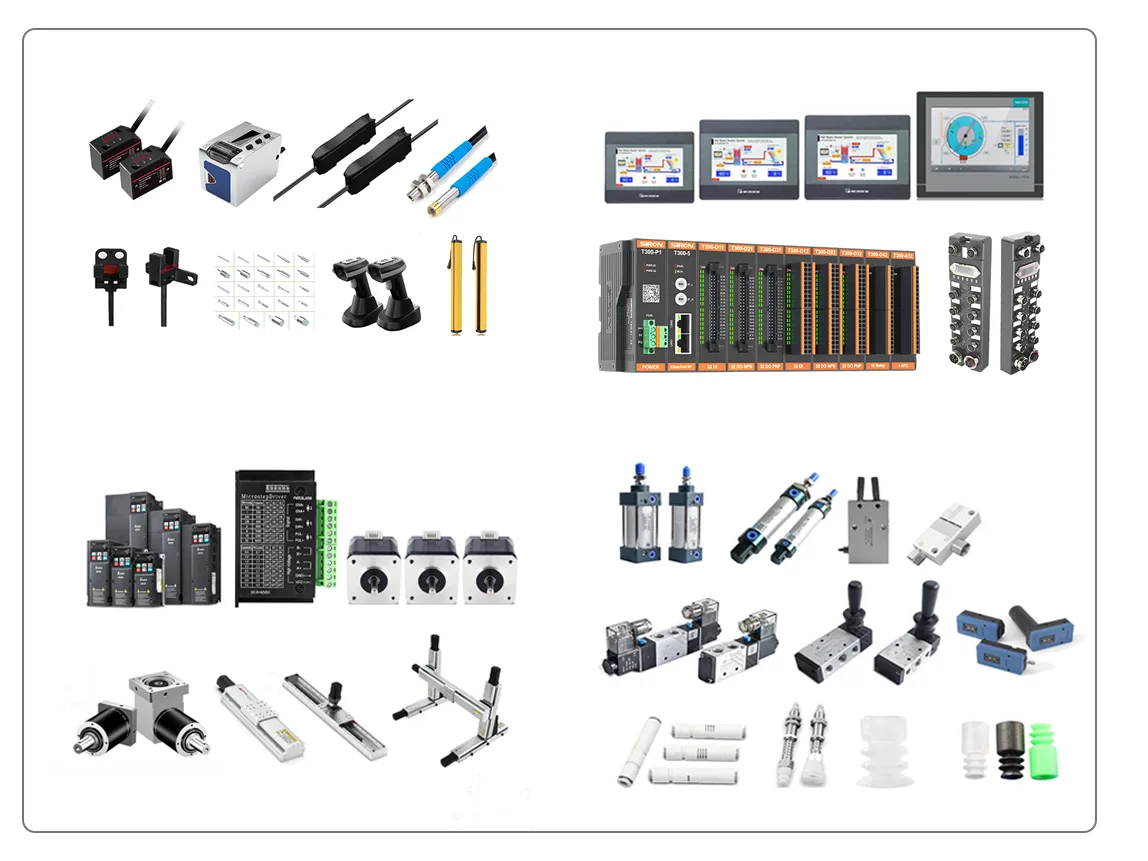
The drive system of industrial robots can be divided into three categories based on power sources: pneumatic and electric. According to the requirements, these three examples can also be combined and combined into a composite driving system. Alternatively, hydraulic power can be indirectly driven through mechanical transmission mechanisms such as synchronous belts, wheel systems, and gears. The drive system consists of a power device and a transmission mechanism, which are used to implement corresponding actions of the mechanism. Each of these three types of fundamental drive systems has its own characteristics, and the current mainstream is the electric drive system.
The control system is the brain of a robot and the main element that determines its function and functionality. The control system retrieves command signals from the driving system and implementing mechanism according to the input program, and controls them. The main task of industrial robot control technology is to control the activity range, posture, trajectory, and action time of industrial robots in the workspace. It has the characteristics of simple programming, software menu manipulation, friendly human-computer interaction interface, online operation prompts, and easy application.
The perception system consists of internal sensor modules and external sensor modules, which acquire meaningful information from the internal and external environmental states.
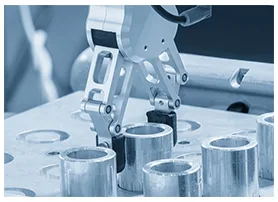
The end effector is a component connected to the last joint of a robotic arm, typically used to grasp objects, connect with other mechanisms, and perform the required tasks. In robot manufacturing, end effectors are generally not designed or sold, and in most cases, they only provide a simple gripper.
The application of industrial robots in various industries
In the field of industrial manufacturing, the trend of automation is accelerating, and automation means being smarter, safer, and more accurate. Intelligence requires the use of robots, so industrial robots are a very important device. It can perform repetitive, tedious, dangerous, or high-precision tasks, freeing traditional labor to learn more innovative work. On the production line, industrial robots can autonomously perform tasks such as component assembly, inspection, and packaging, increasing the production efficiency of enterprises. In addition, the programmability and high-precision control technology of industrial robots can quickly adapt to constantly changing production needs and achieve rapid conversion between batch or small batch production.
In the automotive manufacturing industry, industrial robots have a wide range of applications. Mainly used for welding, assembly, spraying and other processes of automotive parts to improve production quality and efficiency. In China, 50% of industrial robots are used in the automotive manufacturing industry, with over 50% being welding robots; In developed countries, automotive industry robots account for over 53% of the total robot ownership. Moreover, in the manufacturing of automotive parts, industrial robots can also be used in various processes such as mold casting, milling, and clamping, improving production efficiency and yield.
In addition, in the electronics and electrical industry, industrial robots are mainly used for processes such as electronic component mounting, testing, and sorting, to improve production accuracy and speed. At present, the most installed industrial robots in the world’s industrial sector are SCARA type four axis robots and series articulated vertical six axis robots. In the field of mobile phone production, visual robots can be used to automate a series of processes such as touch screen detection, cleaning, and film application.
In the medical industry, industrial robots also have many applications in the medical field. They can be used for various tasks such as surgery, treatment, and rehabilitation, improving the accuracy and safety of work. In addition, industrial robots can also help hospitals solve the problem of insufficient medical staff and provide patients with more diversified rehabilitation treatment plans.
The current development status of industrial robots in China
The robotics industry is an important and key industry that accelerates the construction of a modern industrial system and the development of new quality productivity. Institutions predict that there will be an annual demand of 1-2 million units in the future, accounting for about 70% of the demand in China’s industrial robot market. In recent years, the scale of China’s industrial robot market has grown rapidly, ranking first in the world for 13 consecutive years, and its market share has exceeded half of the global market for two consecutive years. At the same time, Chinese domestic brand robots have made significant progress and have initially formed a complete robot industry chain.
The reason why industrial robots have emerged as a rising star in the Chinese market is firstly because in terms of cost, robots are usually only a quarter of the labor cost; Secondly, robots can bring many new added values in terms of quality, efficiency, and management. Therefore, under the combined effects of rapid advancements in robot technology, significant price reductions, labor shortages, and rising labor costs, China’s industrial robot industry is experiencing explosive growth.
Prospects for the application of industrial robots
In the field of intelligent manufacturing, the manufacturing industry dominated by robots embodies the development requirements of intelligence, digitization, and networking. The large-scale application of industrial robots in modern industrial production is becoming an important development strategy for enterprises. Modern industrial robots have evolved from single function robotic arms that can only perform certain fixed actions to multifunctional, multi task programmable, highly flexible intelligent robots. Although individual industrial robots in the system are flexible and programmable, most fixed automation production systems currently used have poor flexibility and are suitable for large-scale production of long cycles and single products, making it difficult to adapt to modern intelligent manufacturing models that are flexible, intelligent, and highly integrated.
Therefore, based on the current development environment and manufacturing conditions of robots, the future trend of intelligent manufacturing requires innovation in robot production, and the development trend is gradually shifting towards integration, intelligent informatization, and flexible development.
Integration can provide multifunctional design for industrial robots, enabling them to perform multiple processing steps, optimize production processes, achieve integration of measurement, operation, and processing, reduce cumulative errors in the production process, greatly improve production efficiency and automation level of the production line, reduce time and transportation costs in manufacturing, and be suitable for integrated intelligent manufacturing mode.
Similarly, the future intelligent manufacturing mode of digital factory with “Internet+robot” as the core realizes the perfect integration of robot, Internet, information technology and intelligent equipment in the manufacturing industry in a real sense, covering the production, quality, logistics and other links of factory manufacturing, and is a typical representative of intelligent manufacturing. Combined with industrial Internet technology, machine vision technology, human-computer interaction technology, intelligent control algorithm and other related technologies, industrial robots can quickly obtain processing information, accurately identify and locate operation targets, eliminate the interference of factory environment and the diversity of size and shape of operation targets, realize intelligent collaborative production of multiple robots, and meet the diversified and refined requirements of intelligent manufacturing.
Moreover, by developing an open control system for industrial robots, they can be made scalable and portable; Simultaneously design and manufacture modular and reconfigurable mechanical structures for industrial robots, such as integrating servo motors, reducers, and detection systems in joint modules, enabling production workshops to expand or combine system modules according to manufacturing needs, improve the flexibility of production lines, and have the ability to complete various small batch and customized production tasks.
At present, industrial robot components are not as complex, so flexibility is also limited. In response to this, human-machine/multi machine collaboration is its future development trend. By developing key technologies such as multimodal perception, environmental modeling, and optimized decision-making for robots, we aim to enhance the human-machine interaction experience and collaboration efficiency, achieve complementary advantages between robots and humans in perception, understanding, decision-making, and other aspects, and effectively improve the complex operational capabilities of industrial robots. At the same time, by developing multi machine collaborative technology for industrial robots, distributed collaborative control of group robots can be achieved. Its collaborative work ability improves the efficiency of task execution, and its redundancy characteristics enhance the robustness of task applications, enabling it to complete various high difficulty, high-precision, and distributed job tasks that cannot be completed by a single system.
Information source: Reference address of this article: https://www.eepw.com.cn/article/202405/458896.htm